Bihar, derived from the Sanskrit word “Vihara” meaning monastery is a land shaped by history, spirituality, and ancient wisdom. It is the birthplace of Buddhism and Jainism, two major world religions and the center of some of the most powerful empires in Indian civilization.
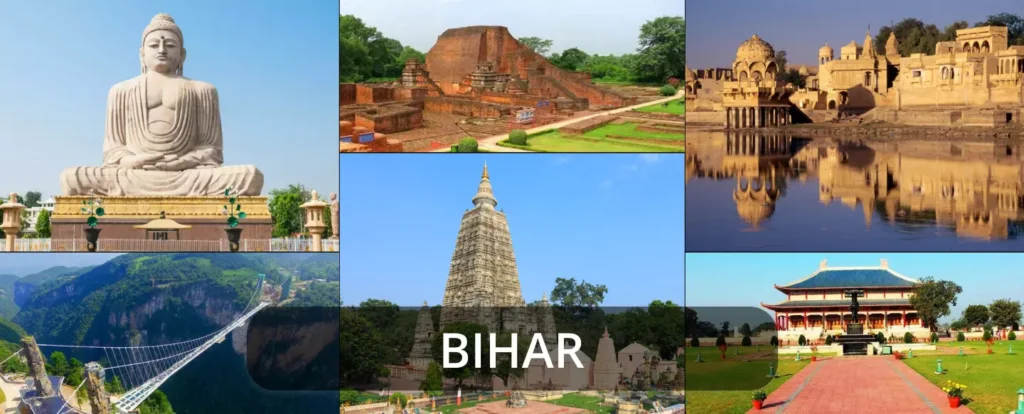
From the mighty Magadha Empire to the golden age of Nalanda University, Bihar has been a guiding force in India’s cultural, political and intellectual journey. Its ancient heritage lives on through its archaeological sites, religious landmarks, traditional arts and the values of the people.
Even today, Bihar continues to play an important role in India preserving its age old traditions while moving steadily toward modern development.
History of Bihar
Bihar’s history stretches back over 3,000 years, making it one of India’s oldest inhabited regions. It has been home to monks, scholars, emperors and reformers whose influence spread across Asia.
Ancient and Classical Period
- Bihar was the heart of the Magadha Empire, which later grew into the Maurya and Gupta Empires two of the greatest dynasties in Indian history.
- The Mauryan ruler Ashoka, one of the world’s most respected leaders, ruled from Pataliputra (modern Patna).
- Bihar gave the world Nalanda University, a global center of learning that attracted students from China, Tibet, Korea, and Southeast Asia.
Spiritual and Religious Heritage
Bihar holds a unique place in spiritual history:
- Buddhism began here Lord Buddha attained enlightenment at Bodh Gaya.
- Jainism flourished here Lord Mahavira spent much of his life in Bihar.
- Sikhism is connected to Takht Sri Patna Sahib, the birthplace of Guru Gobind Singh.
Medieval to Modern Era
- Bihar remained a hub of art, literature and trade through the medieval period.
- During India’s freedom struggle, leaders from Bihar played key roles, including Dr. Rajendra Prasad, India’s first President.
- In modern India, Bihar continues to grow as a center of culture, education and governance.
Geography of Bihar
Bihar lies in eastern India and is known for its fertile plains, river systems and diverse landscapes.
Location & Borders
- Region: Eastern India
- Borders: Uttar Pradesh (west), Jharkhand (south), West Bengal (east), Nepal (north)
Rivers
The state is nourished by several major rivers:
- Ganga – the lifeline of Bihar
- Kosi – known as the “Sorrow of Bihar” due to frequent floods
- Gandak
- Son River
These rivers make Bihar one of India’s most fertile agricultural regions.
Climate
- Hot summers
- Monsoon rains (June–September)
- Cool winters
The climate supports crops like rice, wheat, maize, pulses and sugarcane.
Culture of Bihar
Bihar’s culture is vibrant, deep-rooted and full of traditions passed down over generations.
Languages
- Hindi
- Bhojpuri
- Maithili
- Magahi
- Angika
Festivals
Bihar celebrates festivals with devotion and community spirit:
- Chhath Puja – the biggest festival of Bihar
- Holi & Diwali
- Durga Puja
- Buddha Purnima
- Sonepur Mela – one of Asia’s largest fairs
Folk Art, Music and Dance
- Madhubani Painting – world-famous art form
- Jat-Jatin, Bidesia, Sohar, Kajri – traditional dance and music
- Rich folk songs in Bhojpuri, Maithili and Magahi
Food
Bihar’s cuisine is simple, flavorful and culturally rich:
- Litti Chokha
- Khaja (Silao)
- Thekua
- Dal-Pitha, Kadhi-Bari, Ghughni
Heritage of Bihar
Bihar’s heritage includes towering monuments, sacred sites, ancient ruins and unique art traditions.
Historical Sites
- Mahabodhi Temple, Bodh Gaya – UNESCO World Heritage Site
- Nalanda University ruins
- Vikramshila monastery ruins
- Rajgir – ancient capital of Magadha
- Kesaria Stupa – one of the tallest Buddhist stupas in the world
- Barabar Caves – oldest rock-cut caves in India
- Golghar, Patna
Art & Literature
- Madhubani art tradition
- Ancient Pali and Sanskrit texts
- Modern Hindi, Maithili and Bhojpuri literature
Bihar’s cultural influence extends far beyond the state.
People & Lifestyle
The people of Bihar are known for:
- resilience
- simplicity
- hospitality
- strong family and cultural values
Many from Bihar work across India and abroad, contributing to technology, education, government, business and the arts.
The state has produced influential leaders, scholars, freedom fighters and modern achievers.
Key Highlights
- Capital: Patna
- Districts: 38
- Population: Over 12 crore
- Major Cities: Patna, Gaya, Bhagalpur, Muzaffarpur, Darbhanga
- Major Rivers: Ganga, Kosi, Gandak
- Known For: Ancient universities, religion, culture, agriculture, festivals
Why Bihar Matters
Bihar is more than a geographical region—it is a cradle of civilization, a center of spiritual growth, a land of scholars and a cultural powerhouse.
Its story is timeless, stretching from ancient empires to modern development projects, metro lines, airports, highways, education reforms and rising industries.
Bihar continues to inspire with its history, enrich with its culture and evolve with every new generation.